Published with this product (2)
2024University of California Los Angeles, Master of Science Dissertation
Exploring HOMER1 as a Postsynaptic Marker for Ribbon Synapses in the Peripheral Vestibular Epithelia
Tyler Joseph Kramer
2020Alcohol
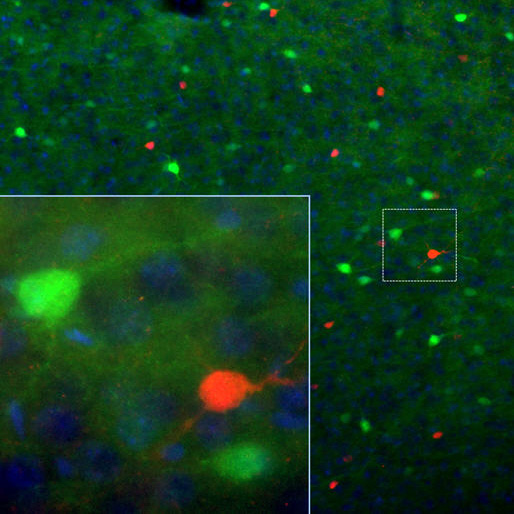
Johnny A. Kenton, Tiahna Ontiveros, Clark W. Bird, C. Fernando Valenzuela, and Jonathan L. Brigman
doi:10.1016/j.alcohol.2020.06.001
Description
Calretinin is a member of the large superfamily of cytoplasmic Ca2+ binding proteins, thus belongs to the subclass of these containing the "EF hand" Ca2+ binding motif originally characterized in parvalbumin. Calretinin is expressed in mammalian central nerve system, testis, fallopian tube and pancreas. In the brain it is localized in certain classes of neurons, and antibodies to it are useful for identifying specific neuronal cell types. It is particularly concentrated in some cerebellar granular cells and their parallel fibers, but is also found in many GABAergic interneurons in the cortex. These GABAergic interneurons, in most cases, express only one of three Ca2+ binding proteins, namely calretinin, calbindin or parvalbumin . As a result, these important inhibitory interneurons can be identified and subclassified based on their content of these three proteins. Each type of neuron as defined in this fashion has particular electrophysiological and functional properties. For example, calbindin positive interneurons are not fast-spiking as are parvalbumin expressinginterneurons. Human calretinin is also known as 29 kDa calbindin and calbindin-2, for its sequence is related to calbindin.
Calretinin contains six EF-hand domains. Four of them bind Ca2+ with high affinity in a cooperative manner, one with low affinity and the last one is non-functional, without Ca2+-binding ability. The function of calretinin appears to be primarily buffering the Ca2+ level in cells and affect intracellular calcium signals. Calretinin deficiency in mossy cells of the dentate gyrus and granule cells results in abnormal excitability in the cerebellar neuronal network and impairment of long-term potentiation and motor coordination. The HGNC name for this protein is CALB2.
This antibody was raised against human calretinin protein expressed in and purified from E.coli. This antibody does not cross-react with the related calcium binding proteins calbindin and parvalbumin (see Blot image).

Related products
For research use only. Not for diagnostic or clinical use.