Description
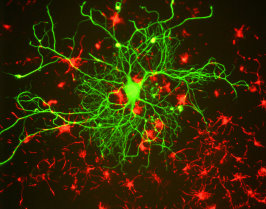
Neurofilaments can be defined as the intermediate or 10nm filaments found in specifically in neuronal cells. In the electron microscope, neurofilaments appear as 10nm diameter fibers of indeterminate length which generally have fine wispy protrusions from their sides. They are found particularly abundantly in axons of large projection neurons. Antibodies to the various neurofilament subunits are very useful cell type markers since the proteins are among the most abundant of the nervous system, are expressed only in neurons, and are biochemically very stable.
NF-L antibody can also be useful in the diagnostics of neurofilament accumulations seen in many neurological diseases, such as Lou Gehrig's disease and Alzheimer's disease. Mutations in the protein coding region of the human NF-L gene cause some forms of Charcot-Marie-Tooth disease.

Related products
- α-Internexin/NF 66
- alpha Synuclein
- Artemin
- Bmi1
- CSF1 (Colony Stimulating Factor 1)
- FGF-2
- GAP43
- GAP43 (IgG)
- MAP2
- MAP2 (Microtubule assoc. protein 2)
- MAP2 (Microtubule Associated Protein 2)
- MARCKS (Myristoylated Alanine Rich C Kinase Substrate)
For research use only. Not for diagnostic or clinical use.