DEV — test website with test data. Orders here are not real and nothing is shipped or charged.

Tech support 866-350-1500

Pay by PO: enter it at checkout

Neuromics

Primary Antibody · Mouse IgG

14-3-3 eta

Species
Human, Mouse, Rat
Applications
WB, IF

Description

The 14.3.3 family of proteins were originally discovered as prominent protein spots on 2 dimensional gels. They are a family of 28-33kDa proteins which are often major proteins of the cytoplasm (1). They function as binding partners for phosphoserine and phosphthreonine sites in other proteins, though they have other binding partners which are not dependent on phosphorylation. These binding interactions are important in the regulation of molecules such as the signaling kinases in the MAP kinase pathway c-Raf and b-Raf, the proapoptotic molecules Bad and Bax and the cell cycle regulator Cdc25.

The 14.3.3 eta protein accumulates in the CSF of patients suffering from Creutzfeld Jacob Disease, and can be used for the diagnosis of this disease. Furthermore, this protein binds α-synuclein in the Lewy bodies of Parkinson's disease and has been linked to early-onset schizophrenia. The HGNC name for this protein is YWHAH.
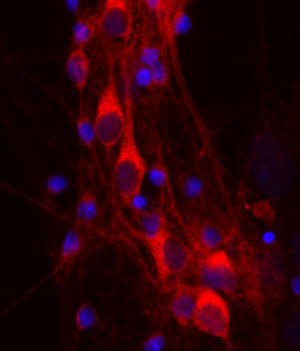
rat mixed neuron/glial cultures stained with 14-3-3 eta antibody (red). Neuronal perikarya are very rich in 14-3-3 eta which has a diffuse cytoplasmic staining pattern. Blue is a DNA stain. Protocol on data-sheet.
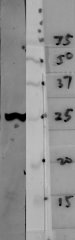
Blots of crude HeLa cell homogenate blotted with 14-3-3 eta (left lane) and various molecular weight standards (right lane- numbers indicate apparent SDS-PAGE molecular weight in kDa). The mouse monoclonal antibody binds strongly and cleanly to a band at about 28kDa. Protocol on Datasheet.

Related products

For research use only. Not for diagnostic or clinical use.