Published with this product (1)
2026Nature
Mitochondrial Transfer from Glia to Neurons Protects Against Peripheral Neuropathy
Jing Xu, Yize Li, Charles Novak, Min Lee, Zihan Yan, Sangsu Bang, Aidan McGinnis, Sharat Chandra, Vivian Zhang, Wei He, Terry Lechler, Maria Pia Rodriguez Salazar, Cagla Eroglu, Matthew L. Becker, Dmitry Velmeshev, Richard E. Cheney, and Ru-Rong Ji
doi:10.1038/s41586-025-09896-x
Description
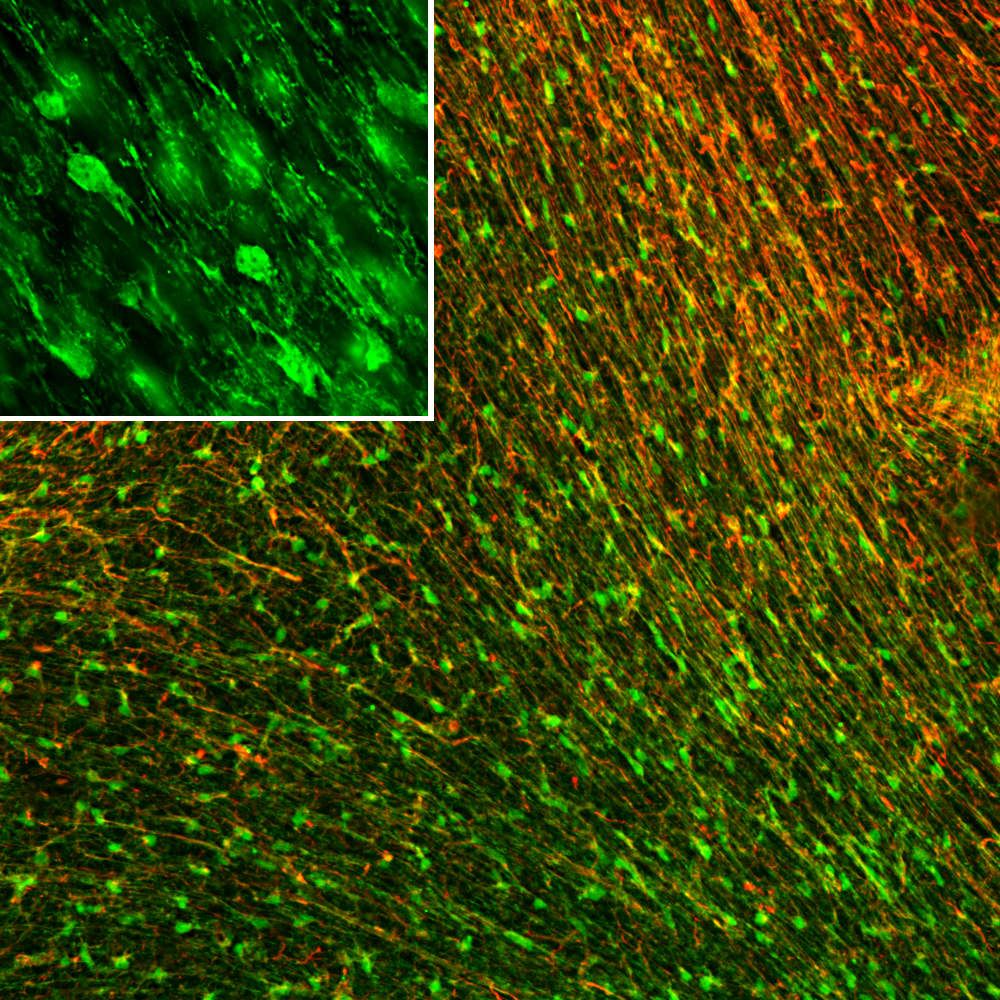
Fatty Acid-Binding Proteins (FABPs) are a family of low-molecular-weight (14–15kDa) intracellular polypeptides that bind and solubilize long-chain fatty acids, thus controlling intracellular lipid dynamics (1,2). Ten members of the FABP family are expressed in humans, each with a specific cell and tissue expression pattern. The seventh member of the family is generally called FABP7 but is also known as brain lipid binding protein or BLBP. FABP7 is abundantly expressed in neural stem cells, radial glia and astrocytes of the developing brain and the retina but is heavily down regulated in the adult.
![Western blot analysis of whole brain and neuron-glial cell culture lysates using mouse mAb to FABP7 dilution 1:1,000 in green, and chicken pAb to HSP60 dilution 1:10,000 in red: [1] protein standard, [2] adult rat brain, [3] embryonic (E18) rat brain, and [4] rat neuron-glial cells lysates.](https://fxhiljpnygjqfppfgycj.supabase.co/storage/v1/object/public/catalog/products/MO22188/neuromics/images/02.jpg)
Related products
- 5HT (Serotonin) Transporter
- Adenylate Cyclase III/ADCY3
- alpha Synuclein
- alpha-II-Spectrin/alpha-Fodrin
- Annexin A6
- beta-Tubulin
- c-Fos
- Calretinin
- CasΦ/Cas12j
- CNP/CNPase
- Fibrillarin
- FOX2
For research use only. Not for diagnostic or clinical use.