Description
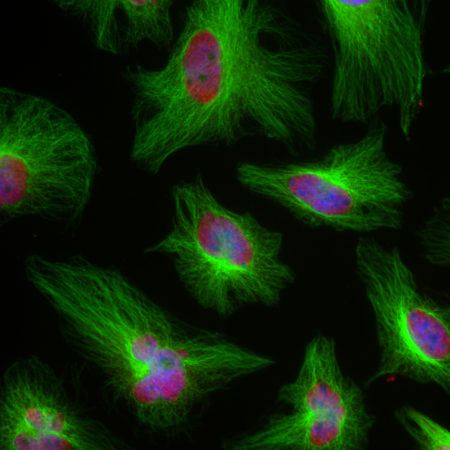
Tubulins are a major class of cytoskeletal proteins and divided into five distinct classes, namely α, β, γ, δ and ε. The most abundant members of this family are the α and β-tubulins which are the major components of cytoplasmic microtubules. The various subunits have molecular weights of approximately 50kDa and are 50% identical to one another at the protein sequence level. Microtubules are involved in a number of essential cellular functions including the maintenance of cell shape, vesicle and organelle transport, cell motility, cell signaling, meiosis and mitosis. The important role of microtubules in forming the mitotic spindle during cell division makes them a desirable target for the development of therapeutic agents directed against rapidly dividing cancer cells.
This antibody was raised against tubulin purified from pig brain. Antibodies to β-tubulin are widely used as loading controls in western blotting experiments as a standard by which the levels of other proteins may be measured.
Product Highlights:
![Western blot analysis of whole tissue or cell lysates using mouse mAb to β-tubulin, MO22202, dilution 1:10,000 in green: [1] protein standard (red), [2] adult rat brain, [3] adult mouse brain, [4] NIH-3T3 cells, [5] HEK293 cells, [6] HeLa cells, [7] SH-SY5Y cells. The strong clean band with apparent SDS-PAGE molecular weight of ~50kDa corresponds to the β-tubulin proteins.](https://fxhiljpnygjqfppfgycj.supabase.co/storage/v1/object/public/catalog/products/MO22202/neuromics/images/02.jpg)
Related products
- Aldehyde Dehydrogenase H1L1 (ALDH1L1)
- ALDH1L1
- Aldolase C
- Beta-Tubulin
- CD11b/c
- Coronin 1a/p57
- Galectin-3 (LGAS3)
- Galectin-3 Rabbit Polyclonal Antibody
- GAP43
- GAP43 (IgG)
- GFAP
- Glial Fibrillary Acidic Protein (GFAP)
For research use only. Not for diagnostic or clinical use.