Published with this product (3)
2019The FASEB Journal
Sensitization of small‐diameter sensory neurons is controlled by TRPV1 and TRPA1 association
Mayur J. Patil, Margaux Salas, Siarhei Bialuhin, Jacob T. Boyd, Nathaniel A. Jeske, Armen N. Akopian
doi:10.1096/fj.201902026R2016University of Louisville, ThinkIR: The University of Louisville's Institutional Repository Electronic Theses and Dissertations
Effects of neonatal capsaicin on formalin-induced ATF3 expression in the adult rat
Sarah Krupp
doi:10.18297/etd/25352012Journal of Endodontics
Expression of Transient Receptor Potential Ankyrin in Human Dental Pulp
Yun Sook Kim, PhD, Hoon Kap Jung, DDS, Tae Kyung Kwon, DDS, Chin Soo Kim, DDS, PhD, Jin Hyun Cho, DDS, PhD, Dong Kuk Ahn, DDS, PhD, Yong Chul Bae, DDS, PhD
doi:10.1016/j.joen.2012.04.024
Description
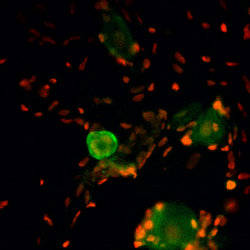
Transient receptor potential ion channels (TRPCs) are a superfamily of six transmembrane segment-spanning, gated cation channels. TRPA1 is a TRP-related channel that responds to cold temperatures and pungent compounds and plays a role in both nociceptor and hair cell transduction. It is a transformation-associated gene product in lung epithelia, whereas its protein distribution is primarily restricted to sensory neurons. Blocking TRPA1 may be a therapeutic target for treating cold hyperalgesia caused by inflammation and nerve damage. It is now known that TRPA1 protein is also widely expressed outside of the CNS and is dys-regulated during oncogenic transformation.
Product Highlights:

Related products
For research use only. Not for diagnostic or clinical use.