Description
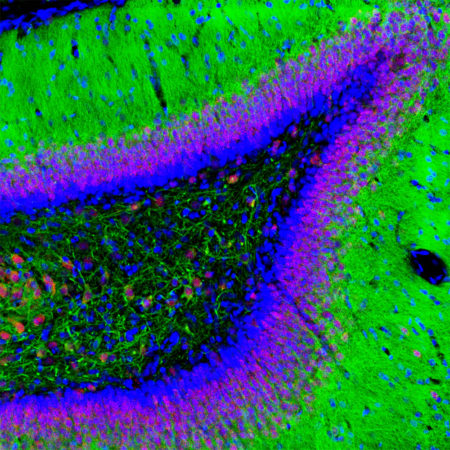
NeuN has become very widely used as a reliable neuronal marker, apparently binding to neurons in all vertebrates tested. The vast majority of neurons are strongly NeuN positive, and NeuN immunoreactivity has therefore been widely used to identify neurons. The differing protein isoforms of FOX3 result from alternate splicing of two exons which code for an insert close to the C-terminus and a short C-terminal extension. The extension includes a C-terminal proline-tyrosine sequence preceded by hydrophobic amino acids (Φ-PY) which is known to target proteins to the nucleus, apparently accounting for FOX3 being present in both nuclei and cytoplasm in certain neurons.
This antibody was raised against a recombinant human FOX3 construct based only on the N-terminal sequence, not including the RRM domain and C-terminal regions. The N-terminal regions of FOX1, FOX2 and FOX3 are relatively poorly conserved so we were able to obtain antibodies which recognized FOX3 but not FOX2 or FOX1.
Product Highlights:
![Western blot analysis of whole brain lysates using goat pAb to FOX3/NeuN, GT22106, dilution 1:1,000 in green: [1] protein standard (red), [2] mouse brain, [3] rat brain. Bands at 46k and 48 kDa correspond to protein isotypes of FOX3/NeuN.](https://fxhiljpnygjqfppfgycj.supabase.co/storage/v1/object/public/catalog/products/GT22106/neuromics/images/02.jpg)
Related products
- α-Internexin/NF 66
- 14-3-3 eta
- Adenylate Cyclase III/ADCY3
- Alpha 2a Adrenergic Receptor
- alpha Synuclein
- alpha-II-spectrin/alpha-Fodrin
- alpha-II-Spectrin/alpha-Fodrin
- Ankyrin 3
- Ankyrin 3/Ankyrin G
- Annexin A5
- c-Fos
- CADM1/SynCAM
For research use only. Not for diagnostic or clinical use.